On this page
- 01Cartagena by the numbers
- 02How locals (and visitors) buy crypto in Cartagena
- 03P2P and payment methods in Cartagena
- 04Where Bitcoin is accepted in Cartagena (BTC Map) and ATMs
- 05Events and communities: what Cartagena has
- 06Remittances to Bolívar
- 07Safety in Cartagena: dating apps and tourist-area scams
- 08Step by step: buying and paying with crypto in Cartagena for the first time
- 09Frequently asked questions
Cartagena is one of the destinations that draws the most foreign visitors to Colombia. But if you arrive planning to pay for lunch in bitcoin, you’re in for a surprise: BTC Map, the community map of places that accept crypto, listed just 2 spots within 10 km of downtown on November 17, 2026. In Cartagena, crypto is something you buy online and rarely use on the street.
This guide is for two kinds of reader. If you live here, we explain how to buy crypto in Cartagena with pesos and how to accept crypto from a tourist without losing money. If you’re visiting, we cover what to expect, how to move around with your crypto, and which traps to avoid in tourist areas. We checked every figure on November 17, 2026.
Cartagena by the numbers
Cartagena’s numbers describe a city that lives on tourism, not on crypto.
2
Places accepting bitcoin within 10 km of downtown
BTC Map, Nov 17, 2026
18–22%
Of foreign visitors' destination preferences went to Bolívar
Anato and Migración, Q1 2026
320,591
Cruise passengers who arrived in Colombia
Anato with Migración data, 2025
US$265 M
Remittances received by Bolívar
Banco de la República via Portafolio, 2025
Bogotá, Antioquia and Bolívar accounted for more than 75% of foreign visitors’ destination preferences in the first quarter of 2026, with Bolívar at 18% among men and 22% among women. Colombia received 4,677,267 non-resident foreign visitors in 2025, up 3.8% on the previous year. Neither of the 2 places BTC Map lists in Cartagena had been verified by the community in the previous 12 months.
Tap a department or a city
- Bo Bogotá · Bogotá D.C. Capital and home of the Superfinanciera and the central bank; host of Cripto Latin Fest and Blockchain Summit Latam. 33 places on BTC Map2.131 M (Cundinamarca) 2025 remittances (USD)
- Me Medellín · Antioquia The city with the most BTC Map places in Colombia and host of Colombia Blockchain Week. 117 places on BTC Map2.079 M 2025 remittances (USD)
- Ca Cali · Valle del Cauca Valle del Cauca receives more remittances than any other department. 7 places on BTC Map3.381 M 2025 remittances (USD)
- Ba Barranquilla · Atlántico Caribbean port: Atlántico received US$483 million in remittances in 2025. 1 places on BTC Map483 M 2025 remittances (USD)
- Ca Cartagena · Bolívar Bolívar draws about one in five foreign visitor preferences. 2 places on BTC Map265 M 2025 remittances (USD)
How locals (and visitors) buy crypto in Cartagena
We found no exchange offices in Cartagena, so everything happens online. If you live here and pay in pesos, you have four routes: a Visa or Mastercard on an international exchange such as CEX.IO, our top pick for that route; Bre-BThe central bank's instant payment system, live since 6 October 2025: money moves in seconds between banks and wallets using a key. (instant bank transfers) or PSEACH Colombia's online payment button that debits money straight from your bank account. (online bank debit) on an exchange with a peso order book, such as Binance or Buda.com; NequiGrupo Cibest's (Bancolombia) money app. Since 1 September 2026 it operates as Nequi S.A. Compañía de Financiamiento, supervised by the Superfinanciera. Its low-amount accounts have caps on balance and movements. or Bancolombia to deposit on Bitso; or P2PPeer-to-peer: you buy or sell crypto directly with another person. The platform holds the seller's crypto until the payment is confirmed..
If you’re visiting, the practical move is to arrive fully set up: an account opened and verified on an exchange that serves your country of residence, two-factor authentication in an app rather than by SMS (which stops arriving when you switch SIM cards), and a small wallet kept separate from your savings. Buying with a card works the same from Cartagena as from home. What you can’t do without a Colombian account is P2P. If you’re staying longer, what changes for you is covered in our crypto guide for expats and digital nomads.
Get your account ready before your trip
Open your account, verify your identity and buy with your Visa or Mastercard. Your bank handles the conversion.
If you work with tourists and they offer to pay in crypto
Guides, hosts, photographers or boat captains may get an offer from a foreign client who wants to pay in crypto. It can be done well, with three rules.
Set the price in pesos and calculate with your selling price. If a service costs COP 300,000 and you’ll sell the USDT on P2P, do the math with what buyers would pay you: on November 17, 2026 they were paying about COP 3,245 per USDT, so you should ask for about 92.5 USDT. Calculate with the official TRMThe official daily dollar-to-peso reference rate, certified by the Superfinanciera. rate of 3,316.70 and you’d ask for 90.5, losing two dollars without noticing.
Get paid in a stablecoin, on a network your platform supports. A StablecoinA cryptocurrency designed to hold a fixed value, usually 1 US dollar, such as USDT or USDC. such as USDT or USDC tracks the dollar and keeps the payment from losing value before you sell. Share your Wallet addressThe public "account number" people send crypto to. It depends on the network; always copy it, never type it. by copy and paste, never by reading it out, and wait for confirmation before delivering the service.
Keep a record. For the DIANColombia's national tax and customs authority. It collects income tax and receives your annual tax return. (Colombia’s tax authority), a crypto payment is a payment in kind valued at its market price on the day you receive it, and if you’re required to issue invoices, the invoice is in pesos. And remember that nobody is required to accept crypto: Banco de la República says it is not legal tender.
P2P and payment methods in Cartagena
P2P is national: the same ads serve Cartagena, Bogotá and San Andrés. On November 17, 2026, among the top 100 Binance USDT ads where you buy, Bre-B keyAn identifier (ID number, phone, email or code) linked to a single account, used instead of an account number to receive Bre-B payments. appeared in 72 to 73, Nequi in 69 to 71 and Bancolombia in 65 to 66. That day USDT sold for about COP 3,265, below the TRM; on other days it can trade above.
If you collect P2P sales in Nequi, mind the cap: Low-amount deposit accountA simplified account (such as Nequi or DaviPlata): the balance cannot exceed 210.5 UVT and neither can monthly outflows. In 2026 that is COP 11,024,727. cannot exceed COP 11,024,727 in balance plus monthly outflows in 2026. In high season that can fall short, so consider switching to a savings account (a one-time COP 15,000 fee) or receiving into a bank account.
The most serious risk is TriangulationA P2P scam: the fraudster pays you with money taken from a third person; the victim reports it and your account is the one that gets frozen.: a scammer tricks a third person into paying you, you release the USDT, and your account is later frozen after the victim’s complaint. Trade only with verified merchants, accept payments only from accounts in your counterparty’s name, and release nothing until you see the money in your own app. In a city with so many visitors coming and going, add one more rule: no crypto-for-cash deals on the street, on the beach or at a hotel.
Where Bitcoin is accepted in Cartagena (BTC Map) and ATMs
With 2 places on BTC Map within 10 km of downtown, and neither verified in the previous 12 months, paying with bitcoin in Cartagena is more a curiosity than an option. We don’t publish business names: with so few places, a stale listing can send you to a shop that no longer takes crypto. If you want to try, call first and always carry a backup plan in pesos.
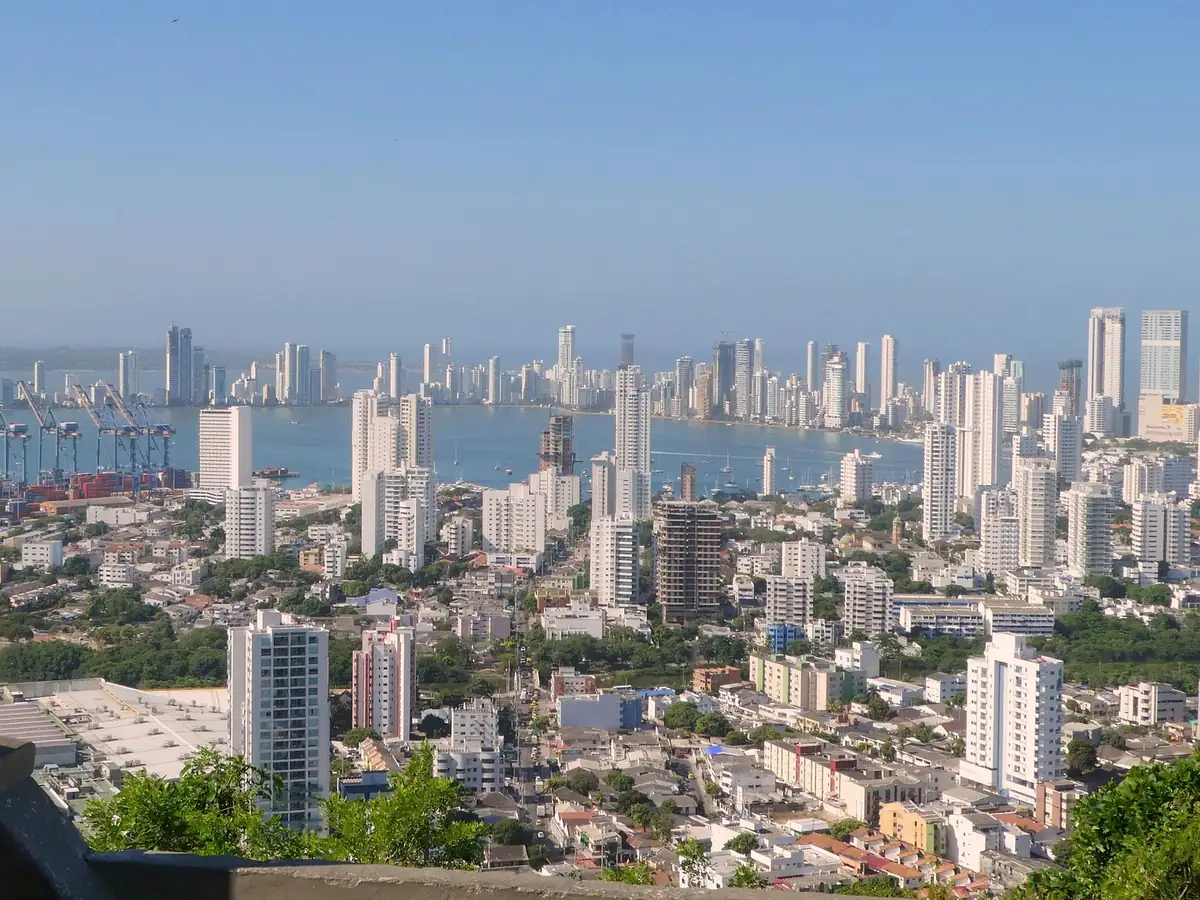
We also could not confirm any Bitcoin ATMs in the city; most of Colombia’s machines are in Bogotá. Day to day you’ll pay in pesos, with cash, a card or a transfer. If you’re a visitor who needs cash, the simplest option is withdrawing with your bank card at a bank ATM, during the day and inside a mall or bank branch if you can. If an informal money changer offers you pesos for crypto on the street, say no: there’s no way to verify the trade and you expose yourself to robbery.
Events and communities: what Cartagena has
We found no crypto events or communities in Cartagena in 2026 that we could verify. The year’s big gatherings happened in Bogotá and Medellín: Cripto Latin Fest at Maloka in Bogotá on August 27 and 28, 2026, Blockchain Summit Latam in Bogotá in early November, and Colombia Blockchain Week at the InterContinental in Medellín on December 11 and 12, 2026.
If you’re a nomad spending a season on the coast, save those dates and keep your crypto social life for those cities. In Cartagena, be especially careful with “investors” or “traders” you meet in bars or on apps who want to talk about your portfolio: that’s the first step in several robberies documented in Colombia.
Remittances to Bolívar
Bolívar received US$265 million in Remesas (remittances)Money that Colombians living abroad send to their families back home. (remittances) in 2025, according to Banco de la República figures published by Portafolio on March 9, 2026: about 2% of the national record of US$13.098 billion, and tenth among the departments on the list, far behind Valle del Cauca (US$3.381 billion).
Sending US$200 through a traditional channel cost an average of 4.96% from the US and 5.48% from Spain in the third quarter of 2025, according to the World Bank, counting fees and the exchange-rate margin. Since January 1, 2026, the US also charges 1% on transfers funded with cash or money orders; transfers funded from a US bank account or with a US-issued card are exempt. The crypto alternative, where the relative buys USDT abroad, sends it over a cheap network and the family sells it here on P2P, can be cheaper, but only if the sender’s purchase isn’t expensive and the recipient knows how to sell without falling into triangulation.
Safety in Cartagena: dating apps and tourist-area scams
In January 2024, after 8 Americans died in Medellín in late 2023, the US Embassy warned that most dating-app-related incidents happen in large cities such as Medellín, Bogotá and Cartagena. The UK government adds that drugs such as Scopolamine (burundanga)A drug criminals use to leave victims compliant and empty their accounts, often after dating-app meetings. are used in Colombia, given through drinks, food, cigarettes, aerosols and even paper flyers, and that criminals use dating apps to lure foreigners.
We found no documented crypto scams specific to Cartagena. These are the traps that are documented in Colombia and that fit a tourist city:
Red flags in tourist areas
- A dating-app match who quickly asks about your investments or your crypto.
- An informal money changer offering pesos for crypto on the street, the beach or at your hotel.
- Someone offering to “help” you with your phone or a payment app.
- Drinks, cigarettes or flyers offered by a stranger.
- An “advisor” promising fixed returns if you invest with them during your trip.
To protect yourself: lock exchange apps with a PIN, not your fingerprint; keep only a small wallet on your phone; meet dates in busy public places; and if you’re robbed, don’t resist. Non-violent scams, from pyramid schemes to triangulation, are covered in our guide to crypto scams.
Step by step: buying and paying with crypto in Cartagena for the first time
This works for locals and visitors alike:
Open and verify your account before you need it
A cédula (Colombian ID card) if you’re Colombian; a passport or another accepted ID if you’re a foreigner. Complete KYCKnow Your Customer: the identity check (ID or passport plus a selfie) exchanges require. and turn on 2FATwo-factor authentication: a code from an app such as Google Authenticator on top of your password. Avoid SMS 2FA where possible. through an app, not SMS.Buy a small amount
For example, COP 100,000 in USDT: about 30 USDT at the P2P price of November 17, 2026. With a card on CEX.IO, the minimum deposit is US$20.Set up a spending wallet
Move only what you plan to use to a wallet on your phone. The sending and receiving networks must match (TRC-20 to TRC-20): copy and paste the address, check the first and last characters, and send a small test first.Keep your seed phrase away from your phone
Write your Seed phraseThe 12 or 24 words that restore a wallet. Whoever has them controls the funds: never share or photograph them. on paper and leave it somewhere safe, not in your suitcase next to your passport. No support agent will ever ask for it.Pay or get paid without rushing
Before paying at a shop, confirm they still take crypto and the peso price. If you’re the one getting paid, wait for confirmation before delivering the service and keep a record.
And whenever in doubt, pay in pesos: in Cartagena it’s almost always the simplest and safest option.
Frequently asked questions
01 Where can I buy crypto in Cartagena?
Online, from your phone: we found no exchange offices in the city. With a Visa or Mastercard you can buy on CEX.IO; with Bre-B or PSE, on Binance or Buda.com; from Nequi or Bancolombia, on Bitso; and on the P2P markets of Binance, Bybit or OKX if you have a Colombian account. Don't buy crypto on the street or from informal money changers in tourist areas: there's no way to verify what you're getting.
02 Are there Bitcoin ATMs in Cartagena?
We could not confirm any: in our research we found no verifiable Bitcoin ATMs in Cartagena, and most of Colombia's machines are in Bogotá. If you need pesos, the simplest route for a visitor is withdrawing cash with a bank card at a bank ATM; for a local, it's selling on an exchange or on P2P and receiving the money in their own account.
03 Which shops in Cartagena accept Bitcoin?
Almost none. BTC Map listed 2 places within 10 km of downtown on November 17, 2026, and neither had been verified in the previous 12 months. We don't name businesses because, with so few places, an old listing can send you to a shop that no longer takes bitcoin. If you want to pay that way, call ahead and always carry a backup plan in pesos.
04 Can I pay with crypto as a tourist in Cartagena?
In practice, barely. Crypto is not legal tender in Colombia, so nobody is required to accept it, and very few businesses do. The realistic approach is to buy crypto before your trip if you want to hold some, pay in pesos by card or cash, and if someone offers to take crypto for a service, pay only after verifying their address with a small test transfer.
05 How do I accept crypto if I work with tourists in Cartagena?
Set your price in pesos and work out how much USDT to ask for using the price you would actually sell at, not the official TRM rate. Ask for payment on a network your platform supports, wait for confirmation before delivering the service, and keep a record. For the DIAN, a crypto payment is a payment in kind, valued at its market price on the day you receive it.
Sources
Facts checked against official sources onNovember 17, 2026.
- Portafolio — Bogotá, Antioquia and Bolívar account for over 75% of international visitors' preferences (May 12, 2026)
- Portafolio — Non-resident foreign arrivals grew 3.8% in 2025
- Scripps News — US says Americans should avoid dating apps in Colombia after 8 deaths
- US Embassy in Colombia — Security alert: risks of using online dating applications
- UK Government — Colombia travel advice: safety and security
- BTC Map — Colombia
- Portafolio — Remittances by department (March 9, 2026)
- DIAN — Unified Ruling 1621 (018075) of 2023 on crypto assets
- Banco de la República — Concept 65714 of 2025 on crypto assets (normograma text)